
Junior Couch Potato Lab

Grade 1-3 Episodes

Exploring the Digital Divide: The Use of Digital Technologies in Ontario Public School
Combining data from a school principal survey with student demographics and achievement data, the present study aimed to develop a much needed understanding of ICT usage in Ontario’s K-12 public schools.

Evaluating Sources in a “Post Truth” World: Ideas for Teaching and Learning about Fake News
Back in 2015, when we published our lesson plan Fake News vs. Real News: Determining the Reliability of Sources, we had no way of knowing that, a year later, the Oxford Dictionaries would declare “post-truth” the 2016 word of the year; that fake news would play a role in the 2016 presidential election; that it would cause real violence; and that the president-elect of the United States would use the term to condemn mainstream media outlets he opposes.

Evaluating Information: The Cornerstone of Civic Online Reasoning
Over the last year and a half, the Stanford History Education Group has prototyped, field
tested, and validated a bank of assessments that tap civic online reasoning—the ability to judge the credibility of information that floods young people’s smartphones, tablets, and computers.
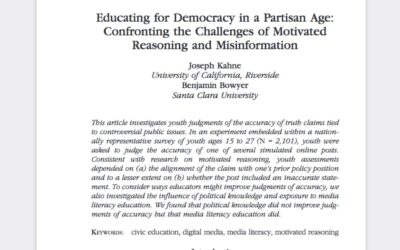
Educating for Democracy in a Partisan Age: Confronting the Challenges of Motivated Reasoning and Misinformation
This article investigates youth judgments of the accuracy of truth claims tiedto controversial public issues. In an experiment embedded within a nation-ally representative survey of youth ages 15 to 27 (N= 2,101), youth wereasked to judge the accuracy of one of several simulated online posts.

Developing Critical Literacies: What We Need to Know is a “Fake News” World
n today’s world, however, the line between real and fake seems increasingly blurred and uncertain. False stories are no longer relegated to tabloid publications but instead have infiltrated more mainstream media sources and social networking services.
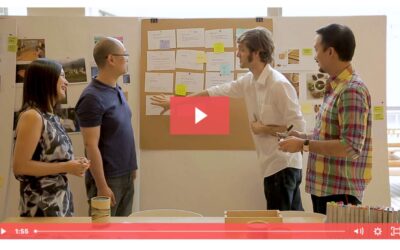
Design Thinking: A Method for Creative Problem Solving
Design thinking is a human-centered approach to innovation—anchored in understanding customer’s needs, rapid prototyping, and generating creative ideas—that will transform the way you develop products, services, processes, and organizations.
Follow Us on Social Media
Don’t miss a minute! Stay connected on your device and get the latest news!


Actua provides training, resources and support to its national network of members located at universities and colleges across Canada in the delivery of science, technology, engineering and mathematics (STEM) education outreach programming. Each year, these members engage over 225,000 youth in 500 communities nationwide. Please visit Actua at www.actua.ca.